
Guide
Buying a Power Station: Wh, Watts, LiFePO4 & UPS Explained
Power station data sheets are full of numbers. Here you will learn which ones really count and how to find the right size for your needs.
Updated 7 min readEditorial team wospeicher.de
Step 1: Work out your own needs
Before you compare models, write down which devices you want to run, how much power they draw and how long they should run. The power draw is shown on the rating plate or power adapter; you can measure it more precisely with a plug-in energy meter. Multiply the power in watts by the runtime in hours and you get the energy requirement in watt-hours.
An example: laptop 45 W × 4 h = 180 Wh, LED lamp 10 W × 5 h = 50 Wh, charging a phone twice ≈ 30 Wh. Together, that is about 260 Wh per day. Add about 15 to 20% conversion losses to this figure if the devices run from the 230 V socket. A power station with 300 to 400 Wh will therefore cover this day.
Step 2: Tell capacity (Wh) and output (W) apart
Capacity in Wh is the size of the tank, output in W the maximum flow rate. Both values need to fit. A power station with 2,000 Wh but only 500 W of output cannot run a kettle. A power station with 2,400 W but only 500 Wh will run it – but only for about ten minutes.
Besides continuous output, peak output (surge) is important. Devices with a motor or compressor – fridge, circular saw, pump – briefly draw several times their rated power when starting. If this value exceeds the power station’s peak output, it shuts down. Some manufacturers offer a mode that runs resistive loads such as kettles at reduced voltage; this works, but the appliance takes longer to do its job.
- Up to 300 Wh: phone, camera, laptop, lights – the classic camping and outdoor class.
- 300–1,000 Wh: cool box, projector, small tools, garden.
- 1,000–2,000 Wh: motorhome, workshop, backup power for individual devices.
- From 2,000 Wh: longer power cuts, heating pump (professionally connected), building site.
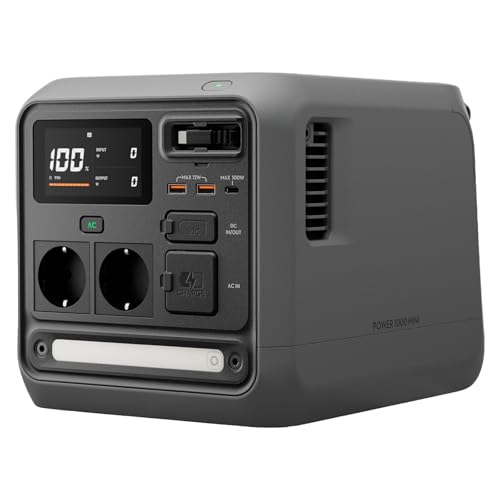
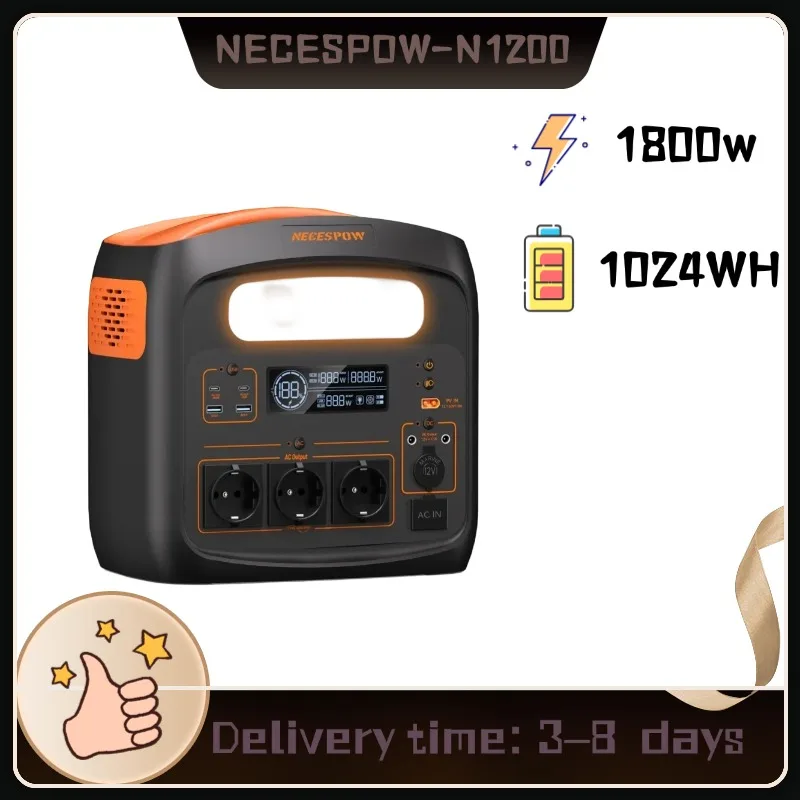
Popular power stations around 1 kWh
Ad All products linked with "View offer" are commission (affiliate) links: if you buy through them, we earn a commission – the price stays the same for you. As an Amazon Associate and eBay Partner Network affiliate we earn from qualifying purchases. Learn more
 Ad−24%
 Ad−34%
AFERIY 1800W1024Wh Tragbare Powerstation, 1Std Schnellladung für Camping …
 Ad−28%
 Ad
AdNewsmy (necespow) N1200 1800W Tragbare Powerstation 1024Wh LiFePO4-Batterie …
Step 3: Battery type – LiFePO4 or NMC?
Almost all new power stations now use lithium iron phosphate (LiFePO4, or LFP for short). This cell chemistry is thermally stable, does without cobalt and withstands many charge cycles – manufacturers often quote 3,000 to 4,000 cycles to 80% remaining capacity. NMC batteries are lighter but usually manage considerably fewer cycles. For devices you use regularly, LiFePO4 is the better choice; for a very light travel power station that is rarely used, NMC may be sufficient.
Important for both types: a good battery management system (BMS) that prevents overcharging, deep discharge, short circuits and overheating. LiFePO4 must not be charged below 0 °C – many units then block charging automatically.
Step 4: Charging options and charging time
A power station is only as useful as it is quick to refill. Modern units charge from the mains at high power and are often full in one to two hours. Charging in the car via the 12 V socket takes much longer. For solar, the maximum solar input and the voltage range of the MPPT charge controller are decisive.
- Mains charging: fast charging with a built-in power supply is more practical than external power bricks.
- Solar: note the input power in W and the maximum open-circuit voltage in V.
- Car: 12 V charging is slow; some manufacturers offer alternator chargers.
- Combined charging (mains + solar at the same time) speeds up charging on some models.
Power stations with solar panel in a kit
Ad All products linked with "View offer" are commission (affiliate) links: if you buy through them, we earn a commission – the price stays the same for you. As an Amazon Associate and eBay Partner Network affiliate we earn from qualifying purchases. Learn more
Ad−28% Ad
AdFOSSiBOT F1800 Tragbare Powerstation 1024Wh 1800W Solargenerator mit …
 Ad
AdALLPOWERS R1500 LITE Solar Generator 1600W Powerstation mit Solarpanel …
 Ad
Ad350W(700W Spitze) Tragbare Powerstation mit 100W Solarpanel,333Wh …
Step 5: UPS function and ports
If the power station is to stay connected to the mains permanently and step in during a power cut, you need a UPS or EPS function with a short switchover time. Values below 20 milliseconds are enough for most PCs, routers and fridges. Check whether the manufacturer explicitly supports continuous operation on the mains.
Count the ports you really need: 230 V sockets, high-power USB-C (60 to 100 W or more for laptops), USB-A, 12 V car socket and, on larger units, possibly a 30 A outlet for motorhomes. A pure sine wave is standard on branded units and essential for sensitive electronics.
Step 6: Weight, noise, app and warranty
As a rough guide, LiFePO4 power stations weigh around 10 to 12 kg per kilowatt-hour. From about 20 kg, carrying becomes a chore; wheels and handles help. During fast charging and under high load, fans run – if you will use it near where you sleep, look out for quiet modes. An app shows consumption and remaining runtime and allows firmware updates. As for the warranty, five years is a good sign, especially with long-life LFP batteries.
Buying checklist
Before you order, go through these points:
- Daily requirement in Wh calculated and 15–20% headroom planned in?
- Continuous and peak output suitable for the most powerful devices?
- LiFePO4 battery with cycle rating and warranty?
- Charging options (mains, solar, car) and charging time suitable for your use?
- UPS function, if the power station is to stay connected to the mains permanently?
- Ports and weight practical for everyday use?
- Price history checked – power station prices sometimes fluctuate considerably.
Common mistakes when buying a power station
The most common mistake is to look only at capacity. A large power station with weak output may be unable to run exactly the devices it was bought for. Equally common: overlooking the solar input. If you want to camp off-grid, you need a powerful MPPT input – otherwise a day’s sunshine will not be enough to refill the battery.
Another pitfall is advertised peak output. Some manufacturers quote a high peak figure that only applies for fractions of a second. For devices with a motor, continuous output is more meaningful. And finally, many buyers underestimate the weight: a 2 kWh power station weighing over 20 kg is not something you casually carry to the campsite.
- Looking only at Wh and forgetting the output.
- Solar input too small for the planned self-sufficiency.
- Confusing peak output with continuous output.
- Underestimating the weight.
- Not recognising refurbished units as such – they are hidden from our topic lists by default.
Worked example: what size for a motorhome?
Assumptions for one day in a motorhome without hook-up: compressor fridge averaging 40 W over 24 hours (960 Wh), lighting 20 W over five hours (100 Wh), water pump and small appliances together about 100 Wh, laptop 50 W over three hours (150 Wh). That adds up to around 1,310 Wh per day. With 15% conversion losses, you end up at about 1,500 Wh.
A power station with 1,500 to 2,000 Wh covers this requirement for one day. With a 400 W solar panel and good sun, roughly 1.5 to 2 kWh is added on a summer day – which would largely cover consumption. In spring and autumn, the same panel delivers considerably less. All figures are example assumptions; your consumption may differ significantly.
Care and storage after purchase
To make your power station last, store it cool and dry at a medium charge level when you will not need it for a while. Top it up every few months so the battery does not become deeply discharged. Keep the firmware up to date via the app – manufacturers often improve charging behaviour and efficiency this way. Avoid leaving the unit in a hot car in summer, and do not charge LiFePO4 batteries in frost. If you keep the power station as a backup reserve, put a reminder in your calendar to check the charge level or use UPS mode on the mains. That way, the unit is ready to go immediately in an emergency.
FAQ
What power station size makes sense for beginners?
For occasional camping, 300 to 500 Wh is enough. If you want something versatile, around 1,000 Wh is often the all-rounder of choice.
How many watt-hours do I need for a laptop?
A 45 W laptop needs about 180 Wh in four hours. When charged via USB-C, losses are lower than via the 230 V socket.
What does pure sine wave mean?
The inverter produces a voltage just like that from a wall socket. This is important for power adapters, motors and sensitive electronics.
Can a power station replace a generator?
For individual devices and shorter outages, yes – quietly and without exhaust fumes. For high output over many days, a generator or a combination with solar is better suited.