
Guide
Is a Battery Worth It for Balcony Solar? Calculation & Criteria
A battery makes your balcony solar kit usable in the evening – but often costs more than the kit itself. This calculation helps you work out whether it pays off for you.
Updated 7 min readEditorial team wospeicher.de
The basic problem: solar power arrives at the wrong time
A balcony solar kit generates most of its power between about 10 am and 4 pm. If you are out during the day, you only use the base load during that time: fridge, router, devices on standby. Everything generated beyond that flows into the grid. In practice, there is no significant payment for this with plug-in solar kits in Germany – the power is lost to you.
A battery captures this surplus and releases it again in the evening and at night. This increases the share of solar power you use yourself, known as self-consumption. How much it rises depends on your consumption profile, the size of the system and the size of the battery.
The example calculation – with clear assumptions
The following calculation is a model. Plug in your own values to get a realistic picture. All figures are rounded assumptions, not measured values.
Assumption 1 – system: 1.6 kWp of panel power (e.g. four 400 Wp panels) with 800 W feed-in power, facing south. Assumption 2 – yield: as a rule of thumb, 1 kWp in Germany generates about 800 to 1,000 kWh per year; because of vertical mounting on the balcony and the 800 W limit, we cautiously assume around 1,100 kWh per year. Assumption 3 – electricity price: 35 cents per kWh. Assumption 4 – household: two people, usually out during the day.
Without a battery, this household might use 35 to 40% of the solar power itself, so around 400 kWh per year. That corresponds to savings of about 140 (euros per year, rounded). With a 2 kWh battery, self-consumption can rise to 70 to 80% – so around 800 kWh. The additional savings from the battery are then about 400 kWh × 35 ct ≈ 140 (euros per year). Charging and conversion losses still need to be deducted from this, realistically 10 to 15%.
- Additional solar power used thanks to the battery: approx. 350–400 kWh/year (assumption).
- Value at 35 ct/kWh: equivalent per year in euros: approx. 120 to 140 (assumption).
- Payback period = extra cost of the battery ÷ annual additional savings.
- If the payback period is well below the expected lifespan (often 10 years or more with LiFePO4), the battery pays for itself.
When a battery is more likely to pay off – and when not
A battery pays off the more surplus your system produces and the more electricity you use in the evening. High panel power – up to the permitted 2,000 Wp – increases the surplus considerably, because feed-in is limited to 800 W: anything generated beyond that cannot be used at all without a battery. With a DC battery, this extra yield ends up in the battery.
- More likely to pay off: out during the day, high evening consumption, panel power well above 800 Wp, high electricity price.
- Less likely to pay off: at home during the day with high self-consumption (home office, washing machine at midday), small system under 800 Wp, heavily shaded panels.
- Borderline case: north-east or west orientation – here the yield partly shifts into the afternoon anyway.
Popular balcony solar batteries
Ad All products linked with "View offer" are commission (affiliate) links: if you buy through them, we earn a commission – the price stays the same for you. As an Amazon Associate and eBay Partner Network affiliate we earn from qualifying purchases. Learn more
 Ad−41%
 Ad
AdAnker SOLIX Solarbank 2 / Pro 3 E2700 / Pro 4 E5000 / Max AC Speicher …
 Ad
Ad2kWh Speicher NOAH 2000 Growatt Batterie für Balkonkraftwerke Solaranlage …
 Ad
AdThe right battery size
More capacity is not automatically better. A battery that only fills up in high summer ties up money you will not get back. A practical rule of thumb: the battery should roughly cover your consumption between sunset and sunrise, as far as the balcony solar kit can supply the surplus. With a typical base load of 100 to 150 W, that is 1.2 to 1.8 kWh over 12 hours.
For systems with 800 to 1,000 Wp, 1 to 2 kWh is therefore often enough. With 1,600 to 2,000 Wp of panel power, 2 to 3 kWh can make sense. Modular systems have the advantage that you can start small and expand later once you know your actual surplus.
Technology: what matters when choosing
The key to the benefit is controlling the output power. A battery that releases a constant 200 W at night even though your household only needs 100 W feeds half of it unused into the grid. That is why modern systems work with a smart meter or a reading head on the digital electricity meter and adjust the output to consumption in real time (“zero export”).
- DC or AC coupling: DC batteries are more efficient for new systems, AC batteries can be connected to any existing system.
- Number of MPPT inputs for panels with different orientations.
- LiFePO4 cells, cycle rating and warranty period.
- Frost behaviour: for outdoor installation, a battery heater makes sense, otherwise the battery will barely charge in winter.
- Emergency power socket for power cuts, if desired.
- App and local interfaces (e.g. for Home Assistant) if you want to integrate the battery into your smart home.
Complete systems with battery and smart meter option
Ad All products linked with "View offer" are commission (affiliate) links: if you buy through them, we earn a commission – the price stays the same for you. As an Amazon Associate and eBay Partner Network affiliate we earn from qualifying purchases. Learn more
Ad−41%AdAnker SOLIX Solarbank 2 / Pro 3 E2700 / Pro 4 E5000 / Max AC Speicher …
 Ad
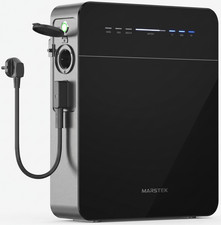
AdMarstek Venus E Mini 2kWh Batteriespeicher LiFePO4 PV Speicher …
 Ad−19%
Legal aspects and registration
For plug-in solar kits in Germany, 800 VA of inverter power and 2,000 Wp of panel power are the upper limits of the simplified rules. Registration takes place exclusively in the Marktstammdatenregister (the national register of energy installations); a separate registration with the grid operator is no longer required. The battery is entered in the register as a separate unit – even if you retrofit it later, you must update the details.
When bought by private individuals, solar panels, inverters and batteries for such systems are generally exempt from VAT (zero rate). Since October 2024, tenants and flat owners in Germany have in principle had a right to install a plug-in solar kit; landlords and owners’ associations can, however, have a say in how it is installed. The product standard DIN VDE V 0126-95 for plug-in solar devices has applied since December 2025; it does not conclusively regulate batteries, so check the manufacturer’s information on standards and safety.
Conclusion: how to decide
First measure your consumption – with a plug-in energy meter on individual devices or via the app of your digital meter. Then estimate your system’s surplus and do the maths with your electricity price. If the battery pays for itself within about seven to ten years and you enjoy a higher degree of self-sufficiency, it is a sensible addition. If not, you are better off investing the money in additional panel power or a more energy-efficient fridge.
Common mistakes in battery calculations
Many calculations online assume that the battery is fully charged and discharged every day. That is often true in summer, but hardly ever in winter. Depending on system and location, around 200 to 300 full cycles per year is more realistic. Conversion losses during charging and discharging are also often forgotten – they are typically 10 to 15%. And finally, savings only increase if electricity is actually used at night: a very frugal household with a 60 W base load can barely make use of a large battery.
Alternatives to a battery
A battery is not always the best next step. It is often more effective to shift consumption into the sunny hours: run the washing machine, dishwasher and tumble dryer at midday using the delay timer, and charge e-bike and tool batteries during the day. Additional panel power – such as a west-facing panel – also extends generation into the afternoon. And finally, it is worth looking at your base load: replacing old fridges or appliances that run constantly saves money regardless of the balcony solar kit. A smart plug with energy monitoring helps you track down such power guzzlers before you invest in a battery.
FAQ
How long does a balcony solar battery last?
Manufacturers of LiFePO4 batteries often quote several thousand charge cycles. At around 250 to 300 full cycles per year, that works out at roughly a decade or more.
Can I add a battery to my existing balcony solar kit?
Yes. DC batteries are placed between the panels and the inverter, AC batteries are plugged into a socket. You then add the battery to your entry in the Marktstammdatenregister.
Do I need a smart meter?
Not necessarily, but it significantly improves utilisation, because the battery only releases as much power as is being used at that moment.
Does a battery make sense in winter too?
In winter the solar surplus is small, so the battery achieves little. Most of the benefit comes from March to October.